

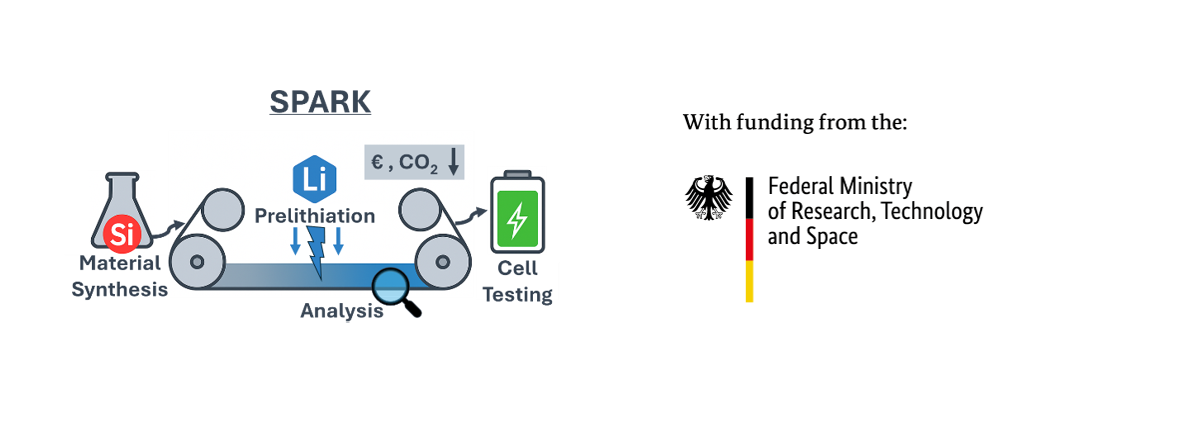
As part of the research project SPARK, PCC Thorion, together with leading research partners – RWTH Aachen University, Forschungszentrum Jülich, the University of Duisburg-Essen, the University of Münster, and ZSW Ulm – is advancing the development of next-generation silicon-based anode materials for lithium-ion batteries. The focus is on enabling the commercialization of pre-lithiated silicon-based anodes to unlock significantly higher energy densities and improved battery performance. The three-year project will start in July 2026 with a total budget of approximately 2.4 million euros and is funded by the Federal Ministry of Research, Technology and Space (BMFTR) as part of the B@TS funding initiative under grant number 03XPB066A with around 1.9 million euros.
At the core of the project is a comprehensive development approach from material synthesis to pilot-scale cell production and validation in commercially relevant pouch cells. Specifically, the project focuses on developing high-performance, cost-efficient, and durable silicon-rich anode active materials in combination with innovative pre-lithiation technologies. This approach addresses one of the key limitations of silicon-based anodes, namely the irreversible lithium loss in the first cycle, which currently limits their commercial applicability.
The project directly addresses key challenges of the European battery industry, particularly the need to translate promising material innovations into commercially viable products. In addition, the project makes a significant contribution to strengthening Europe’s position as a competitive and technologically sovereign battery innovation hub. By advancing silicon-based anode technologies and enabling their large-scale application, the project supports the development of a resilient European value chain and reduces dependence on non-European suppliers.
With PCC Thorion acting as both industrial driver and project coordinator, a strong focus on real-world applicability and market relevance is ensured. The close collaboration between industry and leading research institutions enables the rapid transfer of scientific results into practical solutions.
